


Should you take action?
When life changes, so do the consequences of the decisions you make

Is it time to take a step back?
At some point, financial decisions start to carry greater consequences. It could be more capital, greater responsibility, or decisions you haven’t faced before.
Nothing is necessarily wrong, but it becomes more important to make well-considered decisions. You may feel that you want to avoid mistakes, but lack a clear basis for feeling confident in your choices.
You don’t need to have all the answers before you get in touch. For many, the first step is to pause and get an overview.
Why many people wait too long
- There is no clear decision that feels urgent right now
Even though finances have become more complex, there is no real sense of urgency in everyday life - It’s unclear where to start
You have several questions, but lack a clear direction for what to address first - Things are working well enough as they are
The money is invested and things are running smoothly, without anything prompting change - The consequences feel greater than you’re comfortable with
When it feels important to get it right, it’s often easier to postpone than risk making the wrong decision - You haven’t found the right person to discuss this with
Conversations often focus on individual investments, rather than how everything fits together - It’s easy to delay
You’ve thought about it several times, but other things have been easier to prioritise
Typical situations where it pays to take action
You’re considering selling your business, but haven’t yet decided what comes next.
Typical questions:
-
What should the capital be used for?
-
How should it be structured?
-
What should I have in place before a potential sale?
Divorce, a new relationship, a new venture or changes in the family can have a significant impact on your finances.
When the circumstances change, it’s often natural to reassess structure, ownership and investments.
Typical questions:
- How does this affect my finances as a whole?
- What should be changed in structure and ownership?
- What should be clarified now?
Income will be replaced by capital, and the transition requires a different way of thinking.
Typical questions:
-
What can I sustainably spend each year?
-
Do I have the right level of risk now?
-
How do my choices affect the rest of my life?
You’ve built up capital over time, across accounts, investments and schemes.
Each part may work in isolation, but the overall picture is not always clear.
Typical questions:
-
What is the overall risk?
-
Am I paying too much?
-
Do I have a clear strategy?
Your finances span multiple countries, where tax, structure and investments need to be seen in context.
Typical questions:
-
How does this affect tax and structure?
-
How should investments be organized across countries?
-
Who has an overview of the situation as a whole?
You want to make sustainable investment choices, but it’s not always clear what that means in practice.
Typical questions:
-
What is actually sustainable?
-
How does it affect return and risk?
-
How do I avoid greenwashing?
The value is no longer in the business, but in capital that needs to be managed going forward.
Typical questions:
- How should the capital be structured?
- What should be done first?
- Which choices are difficult to reverse later?
Wealth needs to be passed on, often across people and generations.
Typical questions:
-
How should the wealth be structured?
-
Who should make which decisions?
-
What works over time?
Retirement is often postponed, either because it feels far away or because it seems to be handled through existing schemes.
Yet few have seen what this will actually mean in practice, or how it affects future choices.
Typical questions:
-
What have I actually saved in total?
-
What will it provide later?
-
Should anything be adjusted?
You are considering investments with long-term consequences.
Typical questions:
-
What does this choice really involve?
-
How does it affect the overall picture of my finances?
-
What should be clarified before moving forward?
Assets need to be distributed and secured, often with regard to a spouse, children or dependants.
Typical questions:
-
How should the assets be structured?
-
What should be clarified legally and financially?
-
How do I ensure that it works over time?
You’ve made several decisions yourself, but want an independent sparring partner to assess the full picture before taking the next step.
Typical questions:
-
Are my investments working together as they should?
-
Am I taking the right level of risk – or more than I realise?
-
What should I do differently going forward?
What often happens if you don't take action?
If you don’t take action, it can lead to:
-
You may take on more risk than you’re comfortable with
-
Your capital develops without a clear direction
-
Decisions are made in isolation rather than as part of a whole
-
The advice you receive is not based on an overall plan
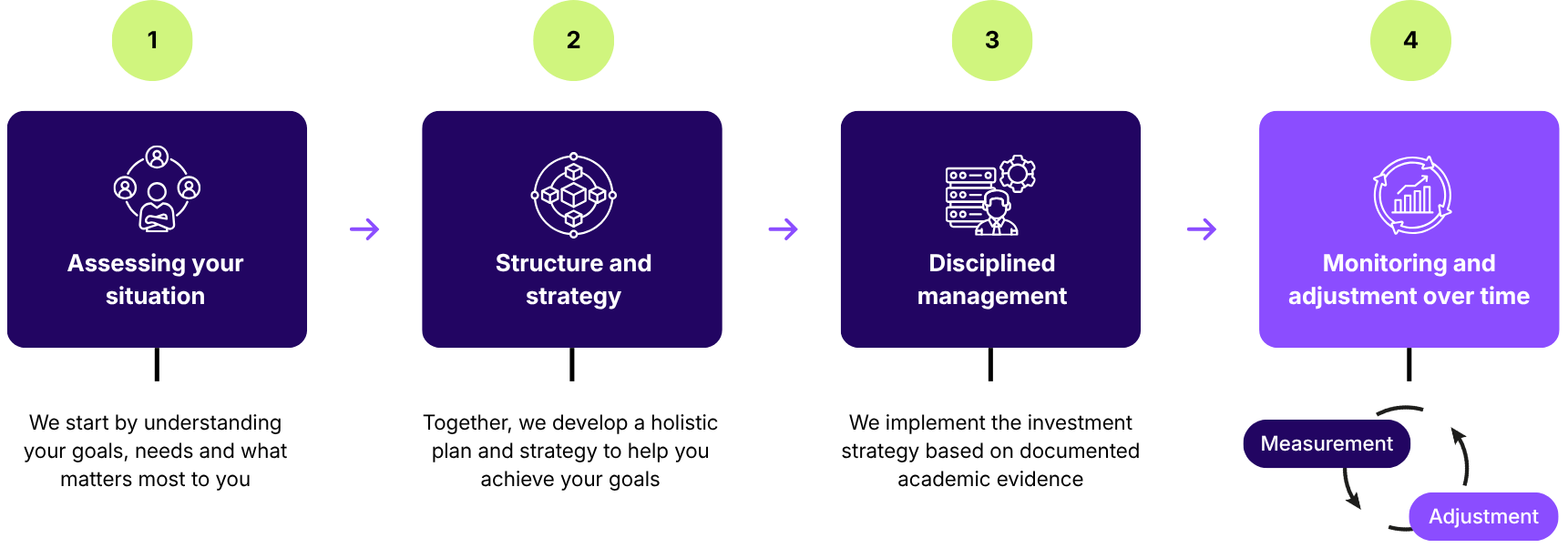
How we work in these situations
How do I know if this applies to me?
This is relevant for you if you:
-
feel that your finances have become more complex
-
are facing decisions with long-term consequences
-
want an independent assessment before taking action
FAQ
You don't need to have all the answers before you get in touch
A short conversation can help you clarify whether this is a good time to stop.